Basic Home Security - Part 1: Where do I even start?
What is “home security” and why should I care?
We’ll define home security here to include all measures taken to preserve the safety, belongings, and peace-of-mind of a home’s occupants from anyone who is not welcome on the premises. As for why you should care… well, presumably you have a basic sense of self-preservation and would rather not live in fear in your own home, right? So with that out of the way, let’s get started!
To decide how to approach home security, we first have to understand 4 main factors:
- Your goals
- Your threats
- Risk
- Tradeoffs
Understand your goals
Presumably, personal safety (and that of your loved ones) is going to be your top goal. But what comes next? Protecting your stuff? Which stuff? Replaceable goods, like TV sets? Irreplaceable family heirlooms? Your data, like credit card info or family photos? Your money? Your car? Your house itself? And where does the “peace-of-mind” fit in? And what about your family’s goals?
Understand your threats
What exactly is most likely to happen? Fire? Flood? Earthquake? Vandalism? Home invader?
If you’re worried about a home invader, which kind? Chances are that nobody is breaking into your home to murder you; they’re probably looking for a way to make some easy cash. They’ll most likely try to break in when they think nobody is home. But what if there is a confrontation? Do you know what to do?
This article will largely focus on burglary (someone breaking while you’re gone to steal your stuff), and to some extent, home invasion (someone breaking in to potentially harm you or your family; a lot less likely). However, being prepared for other situations (like natural disasters) is equally (if not more) important. See here for more information on disaster preparedness: LINK
If you’re still reading this article, I can only assume that you are in fact concerned about burglary. But which kind of burglar? A pragmatic one who is just going to grab a few obvious valuables and go? A crazed drug addict who ransacks the entire place? A professional coming in with a blowtorch and safecracking tools? A business competitor searching for your secret formula? An identity thief coming to scoop tax returns, credit card numbers, and banking passwords from your laptop (or file cabinet)? (LINK to computer security post)
What happens if you lose more than just what’s stolen? Maybe you needed that laptop for work, or they stole your commuting vehicle, and now you’re facing potential job loss as well. Can you afford to replace at least the essentials? Can you afford to live after an emergency? See here for more information on financial preparedness: LINK
Understand risk
“Risk” is a term used to describe how worried you should be about something. It is often calculated as “how bad the event would be” (impact) multiplied by “the chances that it will actually happen” (likelihood). For example, a meteor strike might be a devastating event, but it poses little risk due to the incredibly low probability of it actually happening. On the other side of the spectrum, there’s a pretty good chance that I’m going to step in dog poop on my way to work some day, but that also poses little risk, since the damage is but a minor (albeit smelly) inconvenience at most.
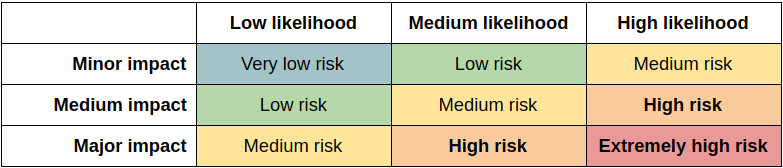
When prioritizing which threats to address, you want to focus on the ones that pose the highest risk. That means the things that are both quite bad and quite likely to happen. This will be different for everyone. For example, if you live in the mountains in the middle of nowhere, your risk of burglary is low (due to low likelihood and medium impact), but the risk of a blizzard trapping you and knocking out your power might be concerningly high (due to medium likelihood and major impact).
Obviously, the concept of risk is generally useful and can be applied not just to home security, but also preparedness in general. For example, if you know that you’re prone to headaches, why not carry some ibuprofen wherever you go? Even if the impact of a headache is minor/medium, the likelihood is high and the cost to you is low, so it’s a solid investment. Speaking of cost…
Understand tradeoffs
Security is all about tradeoffs. Nothing is ever free. If you want better security, it’s going to cost you in money, time, and/or effort (physical and mental). Always keep in mind whether any measures you take will be worth it in the end. Ask yourself questions such as these:
- Is it worth it to buy a $50 fire extinguisher to prevent my home from burning down after a simple cooking accident? (hint: yes)
- Is it worth it to buy a $500 safe for just $200 of valuables? (hint: probably not)
- Is it worth it to buy a $500 safe to protect precious family heirlooms?
- Is it worth the money to upgrade your locks and put bars on your windows?
- Is it worth the money and hassle to install and maintain an alarm and/or camera system, and make sure all family members, guests, etc. learn how to use it?
- Is it worth the hassle to regularly secure and/or hide valuables that you use every day, e.g. laptops?
- Is it worth it to always make sure your doors/windows are locked and your curtains closed whenever you leave the house or go to bed?
One of my favorite guiding principles is the 80-20 rule, AKA the Pareto Principle (LINK to article), which states that roughly 80% of causes are due to roughly 20% of the effects. Using this, we can roughly estimate that just 20% of the employees at your office do 80% of the work, or that 80% of your Facebook feed is from just 20% of your friends. We’re going to use the 80-20 rule a bit differently here though.
First, consider all the things that could go wrong, and then consider all of the resources (money, time, mental energy, etc.) you could expend to prepare for them. Suppose you could solve all of these problems by simply SPENDING ALL THE MONEY! But some of those problems are pretty low-risk, right? And you don’t want to spend ALL the money, either. You want to spend as little as possible. You gotta put food on the table. So why not just spend it on the stuff that really matters?
In this case, the 80-20 rule means that you might be able to cover about 80% of those bad situations with only about 20% of the resources. Maybe that ends up being just 20 hours of work and $1000. You’re picking the low-hanging fruit first.
However, the more you try to prepare for, the more expensive things get, both in time and money. Preparing for that last 20% of low-risk scenarios will take a lot more resources than the first 80%; it will take weeks of effort and thousands of dollars at a minimum. And when it comes to security, a 95-5 rule is probably closer to the truth. Trying to become 100% secure takes an insane amount of resources compared to getting “pretty secure”. And even with infinite resources, you’ll still never actually reach “100% secure”.
You may know this phenomenon as diminishing returns, and it’s ever-present in the security world. At some point, you’ll just have to be satisfied with an 80% or 95% or even 99.9% solution, knowing that you can’t possibly prepare for everything.
Luckily, there’s usually no need to be 100% secure anyway; when it comes to things like burglary, you often just need to be secure enough to not be targeted. You don’t need to outrun the bear, you just need to outrun everyone else. If your house looks like the most annoying one on the block to break into, chances are that a burglar will just go to your neighbor’s house. But if you happen to like your neighbors, then I’d recommend sharing this article with them so that they can be secure too. :)
Conclusion
You’ll need to keep all these factors in mind throughout the rest of this series. After all, you need to know what to protect, what to protect it from, and what (if anything) to actually do about it. They apply whether you’re talking about doors and windows, locks, security systems, cameras, neighborhood choice, and even topics other than home security.
In the next post in this series, I’ll talk about basic security tips regarding:
- Doors
- Windows
- Locks
- Deterrents
- Habits
Until then, stay safe!
-The Readyist